Showing posts with label low-FODMAP. Show all posts

Wednesday, 24 June 2015

The Low FODMAP Festival Survival Guide

Hi Fodmappers

Hope you've got your wellies ready? It's festival time! And you know what that means? Food, drink and festival loos! I know that sounds like a Fodmapper's nightmare but don't panic! A little planning will get you a long way. And with that in mind, here's my ...

Low FODMAP Festival Survival Guide


First choose your Festival

If you have tickets for Glastonbury this weekend then it's probably too late to talk to you about choosing your festival. But for those of you who haven't - this is where a successful festival experience starts! Choosing the festival that's right for you can mean you have an event to look forward to, rather than one you'll dread. This is important, not only because you want to enjoy yourself, but because many people find their IBS is triggered by stress. If the mere thought of a huge festival and thousands of people worries you, then that's not the event for you. Luckily, there are plenty of festivals out there (from rock, jazz, folk, medieval festivals, literary and food festivals - to name but a few) so you're not short of options. So start by choosing one that you will enjoy.

Location, location, location.

When you're thinking about your event, you might also want to think about the location. Big events in far off places are all well and good when you're feeling well. But when you're not, do you really want to be stuck miles from home in a muddy field? Only you know how well controlled (or not) your symptoms are, and how ready you are for the festival loo experience. (We get to that a bit more in a minute). If you're not feeling great (yet) you may want to look for an event happening near to home. You'll be able to relax knowing that you can easily nip off if you do need to beat a hasty retreat.

Food

Once you've decided on your event you might want to start thinking about what you're going to eat. Festivals can be great places to discover new foods and it's likely that there will at least be gluten free and vegetarian options available, but they may not be completely FODMAP friendly. Be prepared to ask whether the food contains onions, garlic, soya etc. This is where food festivals come into their own. The sellers take pride in knowing about the ingredients and in talking to you about the different food on offer. Don't worry about being seen as a fussy eater. At a food festival everyone is a fussy eater. That's kind of the point.

Of course if you're camping you can take a stove, some pans and all the ingredients you'd use at home. You could even make cooking for your friends part of your festival experience. Be sure to remember to pack some wheat free cereals and a carton of long-life lactose free milk for breakfasts.  Rice cakes, peanut butter and bananas are another great festival stand by.

If you're just going for the day, why not take a picnic? Make some gluten-free sandwiches to take with you. Cucumber sarnies with the crusts cut off are so British, and so summery. A tub of salad, some carrot sticks to nibble on, nuts, plain crisps and a selection of cheeses should keep even the hungriest Festival goers happy. Or take a mini barbecue and rustle up some vegetable kebabs and grilled halloumi. Yum!

Drink

Let's face it, festivals are a chance to let your hair down and most people like to enjoy a drink or two (or more) as part of the event. Unfortunately alcohol is a gut irritant and can trigger symptoms for a lot of people. But this doesn't mean you have to avoid alcohol altogether. One glass of wine or one can of beer should be OK - especially if consumed with food.

You should also be aware that coffee, strong tea and certain fruit juices can also trigger symptoms so make sure you have a bottle of water to hand.

Festival Toilets

This has got to be the one thing that makes even the most hardened festival-goer cringe. Festival loos are never the most pleasant (I pity the people who have to clean them) but for Fodmappers they have to be the scariest thing about a Festival. If it's not the long queues then it's the inevitable lack of toilet paper when you get there. But I'm sure you don't need me to remind you to pop some toilet paper into your bag. That's just a normal day out, right?

But if you're going to Glastonbury, you might be in for a pleasant surprise. They now have a range of different loos including provision for people with disabilities. In fact, they are so proud of them that the loos even get their own page on the Glastonbury Festival website. Who would have guessed?

As for the queue, you may just have to forego etiquette and nip to the front. Needs must.

And Finally

Remember that a festival is a great opportunity to meet up with friends, enjoy some fantastic entertainment and most of all, have some fun. So relax (remember that bit about stress?) and have a great time.

'Til next time Fodmappers - Stay fabulous!

Tuesday, 16 June 2015

Ice Cold and Elegant - Introducing Faloudeh

Hi again Fodmappers

Well it's another glorious day here and the garden is alive with bees and butterflies and the hum of distant lawn mowers. I really need to be cutting the lawn too but I just have to share my latest discovery with you first.

Today's recipe comes from an ancient city of 'poets, gardens, wine, nightingales and flowers' where it has been enjoyed for over 2000yrs. Elegant and sophisticated, it's reminiscent of Sherbet and Turkish Delight crossed with a Slush Puppy. It's light and refreshing and the perfect summer treat.

Faloudeh (or Faloodeh) is one of the oldest cold desserts in the world - though I admit I only discovered it recently. (Thanks The Simple Things.) Originating from Shiraz in around 400BC it combines rosewater and lime or lemon juice with sugar syrup and noodles to create a dish which is as exquisite as it sounds.

What's more, it's easy to make, it's suitable for vegans and, of course, it's low FODMAP. And if you're having friends round to dinner, this is going to impress!

Faloudeh


Serves 4

Ingredients

1/2 cup of caster sugar
1/2 cup of water
1 tablespoon of rosewater
Juice of half a lemon
1 block (approx 50g) of rice vermicelli noodles

Optional - Squeeze of lime juice, slice of lemon or freshly picked mint garnish.

Method

Add the sugar and water to a pan and heat until dissolved.
Remove from heat and allow to cool.
Add the rosewater and lemon juice and stir.
Pour into a large tub with a lid and pop into the freezer.

Place rice noodles in a pan and add boiling water.
Allow to stand for slightly longer than the instructions suggest as they need to be soft.
Rinse in ice cold water until cool.
Add to the sugar syrup solution and stir.
Return tub to freezer.

After approximately 1 hr remove the tub from freezer and fluff contents with a fork to break up any ice crystals which are forming.
Return to freezer and repeat twice more at half-hourly intervals.
Allow to freeze for at least 2 hrs.

Serve ice-cold in a glass topped with a slice of lemon, a squeeze of lime juice and a sprig of mint. And maybe a little Persian poetry?

I'm already looking forward to relaxing in the garden with a glass of Faloudeh in my hand. (I have some in the freezer right now). And with that in mind, I'd better get out there and mow the lawn.

'Til next time Fodmappers - Stay fabulous.

Sunday, 7 June 2015

How To Make Tasty Wheat-Free Pasta In Minutes

Hi Fodmappers

I hope you're well and enjoying some sunshine wherever you are? It's been a funny few weeks here but it does seem like summer is finally on it's way. And with summer comes salad!

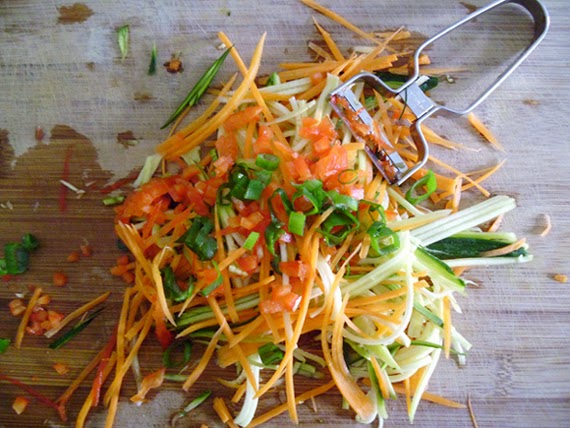
I love salads (I've never understood why some people find them boring?) and earlier this year I treated myself to a spiralizer so that this summer's salads can be even more fun! So today I've been making zoodles!

For those of you who haven't discovered zoodles yet, they are simply courgette/zucchini pasta. (You can't get a lot more 'wheat-free' than that). They are known as zoodles because zucchini + noodles = zoodles. But if you don't have a spiralizer - don't panic! A vegetable peeler will do the trick.

I also made a yummy vegan low FODMAP pesto, because pasta and pesto are made for each other.

This was my first foray into the land of nutritional yeast. I'd never fancied it (you have to admit it doesn't sound appealing) but it's actually very good. It's light and cheesey and, I'm glad to say, not at all yeasty. The finished pesto is fresh and full of flavour. A real 'deli' pesto without the price tag.

So here's how to make a tasty wheat-free pasta and vegan pesto in minutes. Perfect for those summer evenings or for popping into your picnic basket.

Wheat Free Pasta and Low FODMAP Vegan Pesto


Serves 2.

You will need

1 courgette/zucchini
5 brazil nuts
5 walnuts
A good handful of basil
1 tablespoon of nutritional yeast
(Non vegans could replace the nutritional yeast with cheese)
1 to 2 tablespoons of olive oil
Pinch of salt.

Method

Using a spiralizer or vegetable peeler, cut the courgette into ribbons. Set aside in a bowl.

Put the nuts, herbs and nutritional yeast into a mini chopper or food processor and pulse. Add the vegetable oil and salt.

Stir the pesto through the courgette ribbons and serve.

It's really that easy, that quick and and that summery!

And if you happen to be curious about the little flowers in the picture, they are basil flowers and they are fantastic! Too pretty and too tasty not to use.

'Til next time Fodmappers - Stay Fabulous.

Sunday, 10 May 2015

Wheat Free Tabbouleh You'll Want To Share


Hi Fodmappers

National Vegetarian Week is fast approaching and this year it's all about sharing! And as sharing food can be problematic for those with IBS I thought it would be fun to join in with the spirit of this event in a low FODMAP way. So I've come up with a low FODMAP recipe you can safely share with your friends whether they are vegetarian or not.

Tabbouleh is one of those innocent looking summery salads which nevertheless can be problematic for Fodmappers. Most recipes uses couscous or bulgar wheat which are high FODMAP and can cause the symptoms we know too well. Luckily quinoa makes a great low FODMAP alternative.

Quinoa is highly nutritious. It is a complete protein (meaning that it contains all essential amino acids) so it's a particularly useful addition to a vegan diet or whenever extra protein is needed. It also contains magnesium, calcium and manganese, as well as B vitamins and vitamin E. And it's very easy to prepare.

The other Tabbouleh ingredient which can cause digestive problems, is onions. Though I normally replace onions with the green part of spring onions in cooked dishes, I have left them out altogether here and added plenty of herbs and spices instead. I'm pleased with the result - it has plenty of flavour despite the lack of onions. And when sharing food with friends I'm sure you'd rather be safe than sorry. Try it and let me know what you think.


Spicy Low FODMAP Quinoa Tabbouleh


Ingredients

1/2 cup of quinoa
1 cup of water
A little oil of your choice
1 tomato
Approx 3" cucumber
2 Tbsp of olive oil
Juice of half a lemon
1/4 teaspoon of ground ginger
1/4 teaspoon of cinnamon
Fresh coriander
Fresh mint
Salt and pepper

Method

1. Rinse quinoa thoroughly and drain.
2. Heat a little oil in the bottom of a saucepan and toast the quinoa until it stops popping.
3. Add the water to the pan and bring to the boil.
4. Reduce the heat and allow quinoa to simmer until all water is absorbed.
5. Transfer into a bowl and allow to cool. Fluff with a fork.
6. Quarter the tomato and remove the seeds.
7. Dice tomato and cucumber and add to the quinoa.
8. Combine the olive oil, lemon juice and spices.
9. Add a generous amount of coriander and just a little mint to the dressing. Pour over the quinoa salad and stir gently.
10. Season to taste.

Serve with wheat free walnut and rosemary soda bread and a green salad.

Share the love.

'Til next time Fodmappers - Stay Fabulous. x

Sunday, 26 April 2015

Easy Ice-Cream Your Tummy Will Love

If you're looking for an incredibly easy, lactose-free and low FODMAP ice-cream. Here it is!


Hi again Fodmappers

You are not going to believe how easy it is to make this yummy ice-cream. And you might be surprised to learn that all it takes is one banana. Yes, this really is completely lactose free ice-cream which means it's also vegan, as well as being FODMAP friendly. And despite there being no added sugar it's sweetly satisfying. Great for an after dinner treat or for children's parties.

And it takes no time at all to whisk together.

Ingredients

1 small banana per person

Method

1. Slice the bananas into approx. 1" pieces.

2. Freeze for at least 2 hrs.

3. Remove banana from freezer and put into a mini-chopper. Pulse. (You may find you'll need to loosen it from the sides of the chopper with a spoon.)

4. Continue for a couple of minutes until the ice-cream becomes soft and creamy.

5. Enjoy.

I added choc chips to mine (though I added them a little too soon and ended up with speckled ice-cream) and topped it all with coloured sugar stars and one large chocolate star for extra fabulousness. Alternatively, you could try adding a little peanut butter, coffee essence or chopped nuts to the mix.

If you fancy making your ice-cream a little fruitier, remember that to stay within the safe limit of FODMAPs you need to restrict fruit to one portion per meal. By all means add a little raspberry or strawberry but remember to reduce the overall portion size accordingly.

Guess what I'm going to be eating this summer?

'Til next time Fodmappers - Stay Fabulous.

Sunday, 19 April 2015

Low FODMAP Vegan Rainbow Buddha Bowl


Hi again Fodmappers - Guess who's discovered Buddha Bowls?

There is something incredibly satisfying about preparing (and eating) a meal which is as pretty as this, so I'd like to start today's post by saying 'thank you' to Sam for introducing me to Buddha Bowls.

If you haven't come across them yet, Buddha Bowls are a nutritious mixture of raw and cooked foods which typically include a starch, fresh vegetables, a protein, seeds and a dressing. You can make them from left overs as well as from fresh ingredients. I must have been feeling organised as I made mine fresh but prepared enough for a packed lunch the following day.

In fact I must have been feeling more than a bit organized, as though this meal doesn't take long to create, you do need to plan ahead if you want to use home sprouted seeds like I did. I wanted to include sprouted quinoa and buckwheat for the Vegans amongst you as these contain all essential amino acids - and also because I hadn't tried sprouting quinoa before. If you want to do the same you'll need to get them sprouting in advance. Mine were ready for harvest in just 2 days.

I chose to use rice noodles as the starch layer as I wanted to create an oriental style Buddha Bowl (it seemed appropriate) and made an easy, garlic infused ginger and soy sauce to drizzle over the top. Even though I say it myself, it was rather good. But you could just as easily combine meditteranean ingredients such as tomatoes, olives, feta cheese, basil and pine nuts, served on a wheat free pasta base. Get the idea? A Buddha Bowl is less of a recipe and more of a meditation in bringing together some yummy (low-fodmap) ingredients in tasty way.

And as we're often told to include as many different coloured fruit and vegetables as possible, I couldn't resist making a rainbow! Yes, I'm completely embracing my inner hippy with this one.

So here's my Low-fodmap, Oriental inspired, Vegan, Rainbow Buddha Bowl. I hope you enjoy it.


Low-Fodmap Vegan Rainbow Buddha Bowl


I used

Rice Noodles
Slices of Red Bell Pepper
Strips of Carrot
Slices of Yellow Pepper
Slivers of peeled Cucumber
Mixed salad leaves
Finely sliced Red Cabbage
Sprouted Quinoa and Buckwheat
A few Almond slices.
Garlic Infused Oil
Wheat Free Soy Sauce
Grated Ginger

Method

Start by preparing the rice noodles. Simply pour boiling water over the noodles and allow to stand for about 3 minutes. Drain then rinse well in cold water to cool. Leave to drain while you prepare the dressing.

Combine the grated ginger, garlic infused oil and soy sauce to make the dressing.

Place the noodles in the bottom of your bowl and arrange your salad ingredients as you like them. Top with the sprouted quinoa and buckwheat.

Pour the ginger and garlic oil over your salad and sprinkle with sliced almonds.

Relax next to a stream of blossoming lotuses (in your mind at least) as you savour your yummy low-fodmap Buddha Bowl. Reality can wait.


A word about Red Cabbage

At the time of writing this post, the fodmap content of red cabbage has not been analysed. Both Savoy cabbage and common cabbage have been tested by Monash University and it's been found that Savoy has a high fodmap content while common cabbage is low. Having said that, the same source states that up to half a cup of Savoy should be tolerated by most people with IBS, even though it is high. Though this sounds like a contradiction, it should be remembered that fodmaps do not need to be avoided completely but simply kept to a low level. I used only the smallest amount of red cabbage here but if you are concerned that it may be a trigger for you, simply leave it out.

'Til next time Fodmappers - Stay Fabulous. x

Sunday, 12 April 2015

Agave, Aspartame And The Low FODMAP Diet


Hi again Fodmappers

This week I had a message from a friend who, having been advised by her doctor to try a low-fodmap diet, was concerned at some of the things she had read online. She was particularly worried about some of the information she saw regarding Agave and Aspartame ..

'I was disheartened to see that agave was on the bad food list and aspartame was on the good food list.... this has made me lose hope and confidence in fodmap even before starting.'

I should say that my friend, like many of us, tries to eat as healthily as possible, opting for fresh fruit and vegetables and avoiding unnecessary additives as far as possible - so I could completely understand her concerns regarding Aspartame, and her doubts on seeing this recommended as part of a low-fodmap diet. So this post is dedicated to my friend, in the hope that it addresses her concerns.

But before I talk about Agave and Aspartame I want to say a little about Fructose in relation to a low-fodmap diet.

The Low-Fodmap Diet

As regular readers will know, the low-fodmap diet is a process by which a person initially eliminates all high-fodmap foods, later reintroducing them one at a time to identify their personal triggers. (If you're new to the low-fodmap diet, it would be worth you visiting 'What are FODMAPs' before reading on).

Fructose

Fructose is a Monosaccharide (the M in FODMAP) a type of carbohydrate which is poorly absorbed by people with IBS. Though it isn't possible to avoid fructose altogether, it is possible to choose foods which are low in fructose and other fodmaps, and by doing so gain some control over IBS symptoms.

Agave.

Agave has become popular as a 'healthy' alternative to sugar and has been promoted as 'natural' and low G.I. (1) alternative to sugar. It has long been used as a sweetener in South America where it is also used in the production of Tequila. However Agave syrup should be avoided on a low-fodmap diet due to it's very high fructose content.

'Most agave syrup has a higher fructose content than any commercial sweetener -- ranging from 55 to 97 percent, depending on the brand, which is FAR HIGHER than high fructose corn syrup (HFCS), which averages 55 percent.' (2)

Most Fodmappers would realise that high fructose corn syrup is to be avoided, but many people might not realise that fructose is harmful, whether you have IBS or not.

'Your body metabolizes fructose in a much different way than glucose. Fructose is broken down in your liver just like alcohol and produces many of the side effects of chronic alcohol use, right down to the "beer belly".' (2)

Aspartame

Aspartame, an artificial sweetener, is generally chosen by people wanting a low-calorie sweetener, but many fear it is carcinogenic. However, 'the US National Cancer Institute conducted a study of nearly half a million people, comparing those who consumed drinks containing aspartame with those who did not. Results of the 2006 study found that aspartame did not increase the risk of leukaemia, lymphoma or brain cancer.' (3)

But the reason that Aspartame might be included on a low-fodmap diet has nothing to do with whether it is carcinogenic or not, and everything to do with the fact that, unlike Agave, it is low-fodmap and therefore unlikely to trigger symptoms of IBS.

When you see Aspartame included on a list of low-fodmap foods, it isn't that it is recommended that you do include it, it's just that it would be preferable to high-fodmap sweeteners such as Agave.

Other low-calorie options such as Xylitol and Sorbitol are high-fodmap and best avoided for that reason.

Honey vs Sugar

While we're talking about sweeteners I think it's worth mentioning honey and sugar. I think it's fair to say that many of us would presume that honey is healthier than sugar. But from a fodmap perspective, honey should be avoided due to it being high-fodmap. Like Agave it is also high in fructose. Sugar, on the other hand is low-fodmap. Interestingly honey and sugar are listed on the current Monash App (4) but neither Aspartame or Agave are.

If you wish to avoid sugar - Stevia, maple syrup and rice syrup are suitable low-fodmap options.

So, what can we conclude from all this? It certainly throws some of our 'knowledge' of what is healthy and what is not into question. I think we have to remember that a low-fodmap diet is a way to address a specific medical condition. Just as we are used to the idea that many other health problems (such as diabetes, raised cholesterol, coeliac disease and obesity) benefit from certain dietary restrictions, so people with IBS can benefit from changes in what they eat. What is 'healthy' for one person, may not be for another.

But as for Aspartame, I have to say I'd rather go without. Even with evidence to the contrary I'd rather not risk my health, which means I'll probably continue to use sugar (in small amounts) despite the known health hazards! However, I won't be using Agave either.

And maybe that's the answer to this concern? If in doubt, leave it out.

'Til next time Fodmappers - Stay Fabulous. x

1. http://www.nhs.uk/chq/pages/1862.aspx?categoryid=51
2. http://www.huffingtonpost.com/dr-mercola/agave-this-sweetener-is-f_b_537936.html
3. http://www.nhs.uk/Livewell/Goodfood/Pages/the-truth-about-aspartame.aspx
4. http://www.med.monash.edu.au/cecs/gastro/fodmap/iphone-app.html

Tuesday, 7 April 2015

Low FODMAP Vegetarian Kedgeree


Hi again Fodmappers - I hope you've had a great week?

Today I want to share a tasty low-fodmap vegetarian recipe that's already a favourite in our house. It was inspired by one of Hugh Fearnley-Whittingstall's recipes in River Cottage Veg Everyday, we've simply tweaked it to make it low-fodmap. It's easy to make and it's fantastic as a week day supper.

For a vegan variation, simply use tofu instead of egg. Or alternatively, replace the rice with quinoa.

Interesting fact: Did you know kedgeree was traditionally eaten as breakfast as a way of using up the previous night's left-overs. Now there's a thought.


Low-FODMAP Vegetarian Kedgeree (Vegeree)


Serves 3 - 4

Ingredients

2 courgettes
1 red bell pepper (seeded)
1 yellow bell pepper (seeded)
1 aubergine
1 chilli pepper (seeded)
Some spring onion greens
Garam Masala
Olive Oil
Basmati Rice
4 eggs
Fresh coriander

Method

1. Pre-heat oven to 180C/400F
2. Chop all the vegetables into large chunks and spread in a baking tray. Don't be tempted to skimp on the veg. It will look a lot initially but cooks down considerably during roasting.
3. Pour olive oil over the vegetables and generously sprinkle with Garam Masala.
4. Roast in the oven for approximately 40 minutes, stirring occasionally.
5. Prepare the Basmati rice according to the instructions on the packet. Drain.
6. Boil the eggs for 6 minutes. Remove from water and run under a cold tap to cool. Remove shells.
7. Add the vegetables to the rice stirring through thoroughly.
8. Serve the vegeree topped with chunks of boiled egg (or tofu) and fresh coriander.

Enjoy.

'Til next time Fodmappers - Stay Fabulous!

Monday, 23 March 2015

Can A Gluten Free Diet Help IBS?

And how is that different from a low-fodmap diet?


Hi again Fodmappers

I've noticed that there seems to be a lot of confusion surrounding gluten and whether going gluten-free can help reduce the symptoms of IBS, so that's what I want to talk about today. I also want to look at why you need to avoid wheat, barley and rye as part of a low-fodmap diet, and, finally, why some gluten-free products are not suitable for a low-fodmap diet. But first lets look at the difference between gluten and FODMAPs.

Gluten vs FODMAPs


Gluten is a protein (or more accurately a combination of two proteins) found in grains, particularly so in wheat but also in rye and barley, and it is this which gives dough it's stretchy quality. If you have bought flour for baking bread you will probably have bought a 'strong flour' as this type contains more gluten than the flour you might use for cakes or biscuits as bread making needs the elasticity that gluten provides. It's gluten that is a factor in coeliac disease.

Approximately 1 in 100 people in the U.K have coeliac disease. 'Coeliac disease is not a food allergy or intolerance, it is an autoimmune disease. In coeliac disease, eating gluten causes the lining of the small intestine to become damaged.' (1) People who have coeliac disease need to avoid ingesting even the smallest amount of gluten as to do so can cause further damage to the lining of the gut.

Fodmaps, on the other hand, are a group of carbohydrates found, not only in grains, but also in fruit, vegetables, nuts, pulses and dairy produce. 'Current research strongly suggests that this group of carbohydrates contributes to IBS...' (2)

IBS is much more common than coeliac disease, affecting between 1 in 4 and 1 in 10 people at any given time. (3) Though it is a chronic condition, it is a functional disorder. That is to say, the problem is in the way the gut functions, rather than in any damage to the gut itself.

Though wheat, barley and rye contain gluten they are also high-fodmap, and this seems to be where the confusion arises.

If you have IBS you may have discovered that you feel better if you eat gluten free products rather than wheat-based breads, biscuits, cakes, pastas and cereals. However, this is likely to be because, by choosing gluten free, you are also removing high-fodmap grains (such as wheat, rye and barley) from your diet.

A Gluten Free Caution


But if you have IBS, you do not need to avoid gluten, you need to avoid fodmaps. In fact fodmappers need to be careful when choosing 'gluten-free' as these products are designed for people with coeliac disease not IBS. Just because they are gluten-free doesn't mean they are necessarily low-fodmap. Remember fodmaps are found in more than just grains, and gluten-free products may also contain soya flour, apple fibre or inulin (from chicory) all of which are high-fodmap.

So the short answer to the question, 'can a gluten free diet help IBS?', is yes. But it has nothing to do with gluten. I hope that's cleared things up a bit?

'Til next time Fodmappers - Stay Fabulous. x

1. https://www.coeliac.org.uk/coeliac-disease/myths-about-coeliac-disease/
2. http://www.med.monash.edu/cecs/gastro/fodmap/
3. http://www.aboutibs.org/site/what-is-ibs/facts/

Monday, 9 March 2015

Low-FODMAP Rhubarb and Ginger Crumble


You know how sometimes you promise yourself you'll just have a little dessert, and before you know it you're having seconds?

Hi again Fodmappers

I've been longing for rhubarb crumble for a while and finally remembered to buy in what I needed. After dinner this evening I finally got my wish. I love the simplicity and the sharpness of rhubarb. It's real comfort food. And it tastes even better than I remembered.

But I imagine you might be a little cautious about rhubarb. After all, doesn't it have a reputation for being a laxative? Well that's true, but it is also low-fodmap. Confused? Keep reading ...

Without getting too complicated, rhubarb is high in fibre and can be a gentle laxative. Some Fodmappers might find this beneficial as a low-fodmap diet can in fact be low in fibre. However, it can also reduce diarrhoea by adding bulk to stools. (This is not unlike the effect of some prescription laxatives.) But most importantly from our point of view, as it is low-fodmap, we know that it isn't likely to trigger symptoms of IBS. In fact Monash (who we have to thanks for developing the low-fodmap diet) states that up to a cup of chopped rhubarb 'should be tolerated by most individuals with IBS'. (1)

Up to a cup? That sounds like a generous portion of rhubarb to me! And I like rhubarb! So, with rhubarb given the green light, here's my recipe for a tasty crumble.

I used stem ginger instead of sugar to sweeten the rhubarb, partly because I love the combination of ginger and rhubarb, and partly because there is plenty of sugar in the crumble topping. If you don't like ginger, just leave it out and maybe add a little sugar or maple syrup instead.

I also added a little ground almond to the crumble. Up to 10 almonds are low-fodmap and though I haven't calculate how many almonds are equivalent to 1/4 cup of ground, I figure that as the recipe serves 4 this should still be within the 'safe' limit for most people. Of course, if you know you're sensitive to nuts, just leave them out.

One final word of caution - this is yummy! (Even though I say so myself). And as you'll be aware from the discussion above regarding the acceptable amount of rhubarb and almonds, portion size is vitally important when it comes to keeping your tummy happy. If you think you're going to find this crumble hard to resist you could cook it in little ramekins and limit yourself to just the one. And they'd look cute too.

Rhubarb and Ginger Crumble


Serves 4 - 6

For the filling

500g of frozen rhubarb (defrosted)
4 pieces of stem ginger
Approx 2 Tbsp of water

For the Crumble

1 cup of Doves Farm gluten free plain white flour
1 cup of sugar
1/2 cup of butter or vegetable margarine
1/3 cup of oats
1/4 cup of ground almond
1 tsp of cinnamon

1. Place the rhubarb in a pan with the water to prevent it burning.
2. Cut the stem ginger into small pieces and add to the pan.
3. Cover the pan and simmer until the rhubarb begins to soften. Remove from heat.
4. Add the flour and butter to a bowl and rub together until it forms large breadcrumbs.
5. Add the sugar, oats, ground almonds and cinnamon to the flour and stir through.
6. Put the rhubarb and ginger filling into a greased ovenproof dish.
7. Spoon the crumble filling on top.
8. Cook in the oven for approx. 30 minutes.

Enjoy with lactose free cream or yogurt.

'Til next time Fodmappers - Stay fabulous.

(1). From the Monash phone app.

Sunday, 1 March 2015

Low FODMAP Veggie Noodle Pot To Go

Hi again Fodmappers

Today I've got an easy hot lunch idea for you. And because I often forget the vegans amongst us - this one is vegan friendly.

You may remember a few weeks ago I shared a recipe for a Veggie Noodle Soup. Well it occurred to me that it would be easy to make something similar as a noodle pot to take with you to work or college. All you need is access to a kettle or a microwave and a few minutes of preparation the night before.

Vegetarian Noodle Pot


Suggested Ingredients

1 small to medium carrot
1 small courgette
Small piece of sweet pepper
Some spring onion greens
1/2 block of rice noodles
A few small cubes of firm tofu
A pinch of ground ginger
1 tsp of garlic infused oil
A dash of soy sauce
A pinch of sugar
A little salt and pepper

Method

Shred or grate the carrot and courgette.
Finely chop the spring onion greens and red pepper.
Pop all the ingredients into a microwavable plastic soup pot and snap on the lid.

When you're ready for lunch, simply pour on boiling water and allow to stand for a few minutes or add water and pop into a microwave. You'll have a quick, easy and nutritious lunch in no time. Low fodmap to go!


Have a great week - and stay fabulous! x

Sunday, 15 February 2015

Three Ways to Enjoy a Low-FODMAP Pancake Day


Hi again Fodmappers - Can you believe it's almost Pancake Day? It doesn't seem long since Christmas! And it's almost a year since I started my low-fodmap diet! I think that's a cause for celebration!! But pancakes? Why not?

A low fodmap diet isn't about cutting things out, it's just a matter of replacing high fodmap ingredients with low ones. For pancakes that's about choosing a non-wheat flour over wheat, and replacing the milk with a lactose and soy free variety.

Of course you also need to think about what you're putting into your pancakes, so to help you I've come up with three suggestions - one breakfast idea, one main course and one dessert. And because I prefer eating to cooking, they're all very easy.

I've used buckwheat flour for the pancakes (if you've been following my blog a while you'll know that buckwheat isn't wheat) as I like the earthy, wholefood hippiness of buckwheat. But if that's not your style just use a gluten-free flour blend instead. Or maybe try mixing the two together and create a low-fodmap flour blend of your own!

Buckwheat Pancakes


Ingredients

1 cup of buckwheat flour
1 egg
1 cup of lactose free milk of your choice
A little oil for cooking.

Method

Sieve the flour into a bowl. Make a well in the centre and add the egg.
Slowly whisk in the milk.

(After mixing the batter, I poured the batter into a clean plastic milk carton to use as needed.)

Heat the oil in the pan.
Pour in enough batter to coat the bottom of the pan evenly.
Cook until lightly browned, turning once.
________________________________________________________________________

Pancake Fillings and Toppings


Breakfast - Peanut Butter and Banana

Speaks for itself! Enjoy your pancake spread with peanut butter and topped with sliced banana for a protein packed start to the day.

Main Course - Provencale Pancakes

Lightly fry, or roast, some spring onion greens, courgette, bell pepper and tomatoes with a little basil.
Spoon into the centre of each pancake and roll up.
Top with grated cheese and serve with a side salad.

Dessert - Lemon Meringue Pancakes

Warning! This is particularly yummy!

Combine a crushed meringue nest with lemon curd and some plain lactose free or coconut yogurt. (I used CoYo.) Spoon onto cooled pancakes and top with syrup or a squeeze of lemon juice.

I topped mine with a drizzle of syrup from a jar of stem ginger. Lemon and ginger is just such a perfect combination! Yum!

And there you have it - three easy ways to enjoy a low-fodmap Pancake Day. Enjoy!

'Til next time - Stay Fabulous! x

Monday, 9 February 2015

A Low-FODMAP Treat For Valentine's Day


Hi again Fodmappers. How's this for a Valentine's Day treat?

I have to confess this didn't start out as a Valentine's recipe, but this project just grew and grew and this is the finished result. I guess it just wanted to remind you to love your tummy. ;)

So here is my little Valentine's offering to you. It was great fun to do and the combination of flavours is something I know you're going to enjoy. And best of all, it's low-fodmap!!

Sweet Omelette Stack with Raspberry Coulis


You will need

2 eggs
A tsp of sugar (or more to taste)
10 Raspberries
Lemon Curd
Coconut oil (or oil of your choice)

Method

Whisk the eggs and add the sugar. Add the oil to your pan and cook the omelette over a medium heat. I cooked mine as several small omelettes to make them easier to turn, but that's entirely up to you.

Meanwhile, press 5 or 6 raspberries through a sieve to remove the seeds, keeping the remaining raspberries as a garnish.

Using a pastry cutter, cut the omelette into circles and stack, spreading lemon curd between each layer.

Pour the raspberry coulis over the stack and garnish with remaining raspberries to complete your work of heart.

Enjoy as a fantastic Valentine's treat to yourself. You know you deserve it.

Monday, 2 February 2015

Low Cost, Low FODMAP and a bit of Tough Love


Hi Fodmappers

I have my serious head on today as I have seen a few people recently lamenting how they can't afford a low-FODMAP diet and I'm not so sure that's true. I'll be completely honest with you when I say, I even wonder if that's just an excuse not to start. We can all find plenty of reasons NOT to change what we're already doing (it took me years to leave a job where I was no longer happy and I kept finding reasons, or maybe excuses, to stay) but when you know that some simple changes to what you're doing can make you well, what reason would you have not to make that change? (Actually I'm genuinely interested to know what reasons you may have, so please feel free to let me know in the comment box below). 

But back to the issue of cost.

I understand that money can be tight (I only have a part time job myself and have all the usual household costs) but I choose to make my health my priority, and I want to encourage you to do so too. There is nothing -  not your relationships, your family or your job - that will not actually benefit from you looking after your own health. Think about that for a moment. How often have you missed out on a family event or had to let down colleagues at the last minute, because you were ill?

So assuming it is just the cost that is holding you back, here are my tips for an affordable low-fodmap diet. I even let on how I make a meal for two (with some to spare) for less than £3.

Affordable FODMAPs


1. Think about where you shop. A supermarket might be convenient but don't assume that they are always cheaper than your local market or greengrocers.

2. Buy in bulk. Consider ingredients, such as rice and oats, which you can buy in bulk and can be stored in large jars for when you need them. Check out the world foods sections of your supermarket (or visit your local asian store) for big bags of rice. Also a great place to find larger packs of spices.

3. Shop with a friend and share those 'buy one get one free' offers.

4. Buy seasonal produce. Seasonal fruit and vegetables are cheaper than those that aren't. This isn't rocket science but it's easy to forget. There's nothing wrong with treating yourself to some strawberries in the winter, if that's what you fancy, as long as your budget allows.

5. Make the most of potatoes. Potatoes are something of a fodmappers friend. Not only are they cheap but you can bake them, boil them, mash them, roast them, add them to soups, or add them to a curry. You could even try replacing a pastry crust with a layer of mashed potato.

6. Cook in bulk and pop the rest in the freezer. Unless you really enjoy cooking, the chances are that there'll be days when you fancy a day off. That's when you can turn to your freezer and enjoy a meal you made earlier.

7. And that takes me to my final tip. There's no getting away from it, certain low-fodmap ingredients are pricey. Gluten-free bread being a prime example. But if you pop one in the freezer on the day you buy it, you can take out slices as you need them. At least none will go to waste.

And that just leaves me to share my absolutely low cost (less than £3) low-fodmap meal for two.

You'll need a stew-pack (I got mine in Lidl's for £1.50) a couple of potatoes, some spring onion greens and herbs or spices according to your preference.

Simply chop the root veggies into nice chunks, place in cold water and bring to the boil. Once boiling, reduce to a simmer. Add herbs or spices. I like to use some ginger, cumin, turmeric and pepper. I also added a spoonful of yeast extract instead of a stock cube. Stock cubes often contain onion or garlic so are best avoided.

Simmer until you're hungry - and serve. One stew pack made two BIG bowls of soup with enough left over to go in the freezer. So easy, so tasty and so cheap!

So there you go Fodmappers, if you haven't yet started your low-fodmap diet, what's stopping you? Not the price I'm sure. ;)

'Til next time - Stay Fabulous! x

Thursday, 29 January 2015

7 Low FODMAP Breakfast Ideas


Hi again Fabulous Fodmappers - How are you? (I don't call you 'fabulous' enough, but I hope you know you are?)

I apologise for being a little late with this weeks post, I'm just getting over a sinus infection. Looking on the bright side I managed to avoid antibiotics which I'm happy about as I don't want to mess with my gut flora if I can avoid it. I think it just needed a little time and rest.

But I'm happy to say I'm feeling better now and back to my usual excited self. I can never quite express how much going low-FODMAP has changed my life for the better, but I know there are some of you who still find the whole thing daunting. (I did at first too). I also understand that if you're still quite poorly with your IBS, you probably don't want to spend hours searching the net for info. So I thought this week I'd just share some different low-FODMAP breakfast suggestions to inspire you.

As always, the suggestions here are vegetarian (because I am). If you wish to include meat in your low-FODMAP diet you can do as meat does not contain FODMAPs. Just be sure to avoid anything too fatty as that may trigger symptoms too.

7 Low-FODMAP Breakfast Ideas 


1. Porridge made with lactose-free milk and sweetened with banana, raspberries, blueberries or strawberries. (Any of these fruit are suitable but remember to keep to one portion with each meal to keep fructose levels low). I also like to add a little coconut oil and a sprinkle of cinnamon to mine. More info on bananas here.

2. Omelettes make a great protein packed breakfast and you can add tomatoes, spinach, courgette, spring onion greens, cheese and herbs to make it the way you like it.

3. Scrambled tofu on gluten free bread makes a nice breakfast which is not only low-FODMAP it is also suitable for vegans. But note, not all gluten free breads are low-FODMAP. Check the ingredients list to be sure the bread does not contain soya or apple.

4. Fancy something sweet in the morning? How about buckwheat pancakes with maple syrup? (For more on buckwheat click here). Again be sure to use a lactose free milk.

5. Make your own muesli. Shop bought muesli tends to contain wheat, dried fruit or whey powder which you want to avoid. So make your own from ingredients such as quinoa flakes, rice flakes, oats, nuts, seeds and dried banana chips. Yum!

6. Or what about cheese and tomatoes on gluten-free toast?

7. And finally, Rice Krispies! Ok that might not sound like the healthiest breakfast option but they are low-FODMAP (of course the lactose-free milk rule will apply) and I like to show you that low-FODMAP doesn't have to be complicated. I think it's also good to know there are easy options for children with IBS.

So there you have it, a different breakfast idea for every day of the week. And I didn't even include muffins. You might also like to check out the Chachouka recipe here. (Doesn't that make 9 suggestions in total?)

If you have any more ideas - please post them in the comments below. In the meantime, be nice and share this post on facebook, pinterest and google + using the icons below. Chances are that some of your friends also have IBS and don't like to talk about. A click from you could help them on the road to recovery. Many thanks - and stay fabulous!

Sunday, 18 January 2015

Sunshine, Lemon and Raspberries.


Hi Fodmappers - I hope the sun is shining where you are?

It's been a beautiful day here today, the kind of day which puts you in mind of summer desserts. And as I have wanted to make these for a few days, today seemed the perfect day for them. They are also incredibly easy to do. (I made these in the length of time it took to also make a cup of tea).

All you need is

  • Some ready made meringue nests
  • A jar of lemon curd
  • Some raspberries
  • A bar of dark chocolate.

Simply spoon some lemon curd into the meringue nest. Top with raspberries and flakes of dark chocolate. (To make the chocolate flakes, simply shave the bar of chocolate with a knife).

And there you have it. A taste of summer, any time of year.

The sharpness of the raspberries goes wonderfully with the lemon and the meringue. And I just love dark chocolate! Of course, these are also low-FODMAP, but you'd never know. I always think that us Fodmappers miss out on so much, it's good to have a treat now and then. And if you're entertaining, these are something everyone could enjoy.

Try them and let me know what you think.

Tuesday, 6 January 2015

Quick, Light and Low - Veggie Noodle Soup


Hi Fodmappers - How is that New Year's Resolution coming along? Discovering plenty of tasty low-FODMAP recipes? Don't panic if everything seems strange right now, you'll get the hang of it I'm sure. And to help you along I thought I'd share a recipe of my own for a very simple, fresh and healthy soup that you can make in minutes.

Low-FODMAP Veggie Noodle Soup


Suggested ingredients

Rice noodles
Carrots
The green part of spring onions
Red bell peppers
Tofu
Soy Sauce
Ginger (either a small piece of root or a pinch of ground ginger)
Salt
Black Pepper
Lemongrass
Coconut Oil (though any oil will do)
Water

Method

Finely chop the carrots, peppers, spring onion greens and ginger.
Prepare lemongrass by peeling away leaves and squashing the tip with a rolling pin to release the flavours.
Cut tofu into small cubes.

Lightly cook the vegetables in a little oil until they begin to soften.
Add boiling water, lemongrass, soy sauce, salt and black pepper. Reduce to a simmer for a few minutes.
Add tofu and warm through gently.

Put the rice noodles into a bowl, remove the lemongrass from the pan and pour your soup over the noodles. Allow noodles to soften in the soup for approx 3 minutes.

And that's it - quick, light and low-FODMAP. Perfect when you're pushed for time or just want something fresh and easy.

Enjoy.

'Til next time Fodmappers - happy eating!

(Like this recipe? Use the links below to share to Facebook, Twitter, Google+ and Pinterest.)

Monday, 15 December 2014

The Low-Fodmap Christmas Party Guide - Part 2


Not long now and the presents will be getting exchanged, the food will be on the table and the drinks will start to flow. So Fodmappers, do you know what and how much you can drink this Christmas? And whether you can even drink alcohol on a low-FODMAP diet.

Let's start with the good news.

Alcohol

According to Monash University (who we have to thank for developing the low-FODMAP approach to IBS) the following alcoholic drinks should be OK to include in your celebrations at the suggested levels. And no it doesn't mean you can have a glass of each. ;)

Beer - 1 Can
Whiskey - 1 x 30ml serving
Red wine - 1 x 150ml glass
Sparkling wine - 1 x 150ml glass
White wine - 1 x 150ml glass

Beware to avoid Rum and low-GI wine as both are high in fructose and may trigger symptoms of IBS.

Non-Alcoholic Drinks

If you prefer a glass of something non-alcoholic you should be aware that both apple juice and orange juice are also high-FODMAP so should be avoided. Also make sure to read the labels of any non-alcoholic fruit punch that may take your fancy. Some of these also contain apple juice.

Cranberry juice, however, should pose no problems and inspired a little mulled beverage all of my own. (See image at the top of the page). So here's my recipe for an easy, winter warmer to enjoy this Christmas.

Mulled Cranberry Punch

Ingredients

A carton of Cranberry juice drink (look for one which does not contain artificial sweeteners as they may be high FODMAP. I used Ocean Spray Classic.)

A mulled wine sachet.

Cinnamon sticks. (Optional).

Method

Pour the cranberry drink into a pan, add the mulled wine sachet, and heat gently for a few minutes.
Pour into glasses and add a cinnamon stick for decoration. 

And there you have it, Christmas in a glass. 
Serve to your guests with a selection of nuts or 'safe' cheeses and no-one will suspect a thing.

One final note. Remember that FODMAPs are cumulative so try to stick to small portions where you can. Personally I think that this might be the hardest thing to do at Christmas when there is so much good food and drink about but it's better to eat several small meals than one large one so that you keep the FODMAP levels low.

With that in mind, it just leaves me to wish you a very happy and healthy Christmas. May Santa bring you everything you wish for. See you in the New Year.
________________________________________________________________________________

Like this blog? Use the links below to share to Facebook, Twitter, Google+ and Pinterest.

Sunday, 23 November 2014

Low-FODMAP Mince-Pies


Well it wouldn't be Christmas without them, would it?

Hi again Fodmappers. This will be my first Christmas since going low-fodmap and I realised I'm going to have to get organised if I want to enjoy some festive treats. So for the last few weeks I've been thinking about the things that really make Christmas for me, and mince-pies have got to be top of my list.

But mince-pies are normally a bit of a fodmappers nightmare. First there's the wheat in the pastry, but even if you go wheat free there's still the apple and dried fruit in the mincemeat. If you're buying ready made there may very well be other ingredients to watch for too - did someone say fructose-glucose syrup? It was only when I decided to try and create some low-fodmap mincemeat of my own that I discovered there's even fructose-glucose syrup in tubs of candied peel!

Eventually I struck on an idea, after all there are other Christmas flavours to be had. So here's my own twist on a Christmas favourite. These are vegetarian, wheat-free, gluten-free, apple-free and don't even contain the dried fruit that is normally found in mince pies - but are still very tasty. If you're vegan you could try replacing the butter with coconut oil. I haven't tried that but I imagine it would be yummy.

The directions below are for 12 mince pies. I hope you enjoy them.

Ginger, Orange and Walnut Mince-Pies

Pastry Ingredients

200g Gluten Free Plain White Flour
100g Butter
75g Cold Water

Mincemeat ingredients

6 x 1" Pieces of Bottled Stem Ginger
Zest of 1 Orange
Juice of 1 Orange
Zest of 1 Lemon
1/2 Tsp of Ground Cinnamon
1/2 Cup of Chopped Walnuts

First prepare the pastry.

Put the flour into a large bowl and add the butter. Work together until it resembles fine bread crumbs.
Add the water and stir through quickly until it begins to form a dough. Shape the dough into a ball and pop into the fridge for at least 30 minutes.

While the pastry is resting, prepare the mincemeat.


Chop the ginger into fine pieces and put into a pan with the orange zest, lemon zest, orange juice and cinnamon. Cook over a medium heat, stirring frequently, until it begins to take on a mincemeat like texture. Remove from the heat and allow to cool a little. Stir the chopped walnuts into the mixture.


Roll out the pastry and cut out circles using a pastry cutter. Be careful handling the pastry as gluten free pastry has less stretch than ordinary pastry. Place into a greased mince-pie tin. Put a dessertspoon of the ginger mince-pie filling into each pie and top with a star cut from the remaining pastry.

Bake in a pre-heated oven at 180C/350F for 20 minutes being careful not to overcook. Eat warm or allow to cool and sprinkle with icing sugar for the perfect festive finish.

Monday, 10 November 2014

Low-FODMAP Eating Out - Problem Solved


I have exciting news Fodmappers - I've found an easy option for meals out!

Up until now my default meal-out option has been jacket potatoes but that does get monotonous, so this evening my partner suggested asking if the pizza restaurant had a gluten free option, and guess what? They did! You wouldn't think someone could get so excited about eating in a pizza restaurant (or maybe you would?) but I was very happy. 

Why hadn't I thought of this before? A place where you can design your own meal from a choice of pizza toppings, and pick and choose from the salad bar is perfect for us Fodmappers. This is somewhere where such behaviour is normal, not fussy (I hate that people might think of me as a fussy eater) and no-one suspects a thing.

So this is my very simple tip for meals out. 

Go to a pizza restaurant (though maybe ring first just to check they do gluten-free pizza bases). Choose toppings which you know are low-fodmap - I had goats cheese, cherry tomatoes and olives, and grab yourself some tasty low-fodmap options from the salad bar. 

Of course, you'll need to avoid the temptation of the bread sticks and mayo-type salad dressings and remember to stick to small portions. I figured out that even the individual size pizza would have taken me over the safe level of tomatoes, maybe for other ingredients too. And sadly, desserts are off limits. Having said that, half a pizza, a bowl of carefully selected salad, and a glass of water was plenty.

I should also say that the food was great! So thank you Jess (our waitress). I doubt she'll ever see this blog but she made us feel very welcome. Which is why this is my second tip of the evening. ;)

So phone your friends, book a table and enjoy your evening - and share this post to solve a problem for others too.