Sunday, 19 April 2015

Low FODMAP Vegan Rainbow Buddha Bowl


Hi again Fodmappers - Guess who's discovered Buddha Bowls?

There is something incredibly satisfying about preparing (and eating) a meal which is as pretty as this, so I'd like to start today's post by saying 'thank you' to Sam for introducing me to Buddha Bowls.

If you haven't come across them yet, Buddha Bowls are a nutritious mixture of raw and cooked foods which typically include a starch, fresh vegetables, a protein, seeds and a dressing. You can make them from left overs as well as from fresh ingredients. I must have been feeling organised as I made mine fresh but prepared enough for a packed lunch the following day.

In fact I must have been feeling more than a bit organized, as though this meal doesn't take long to create, you do need to plan ahead if you want to use home sprouted seeds like I did. I wanted to include sprouted quinoa and buckwheat for the Vegans amongst you as these contain all essential amino acids - and also because I hadn't tried sprouting quinoa before. If you want to do the same you'll need to get them sprouting in advance. Mine were ready for harvest in just 2 days.

I chose to use rice noodles as the starch layer as I wanted to create an oriental style Buddha Bowl (it seemed appropriate) and made an easy, garlic infused ginger and soy sauce to drizzle over the top. Even though I say it myself, it was rather good. But you could just as easily combine meditteranean ingredients such as tomatoes, olives, feta cheese, basil and pine nuts, served on a wheat free pasta base. Get the idea? A Buddha Bowl is less of a recipe and more of a meditation in bringing together some yummy (low-fodmap) ingredients in tasty way.

And as we're often told to include as many different coloured fruit and vegetables as possible, I couldn't resist making a rainbow! Yes, I'm completely embracing my inner hippy with this one.

So here's my Low-fodmap, Oriental inspired, Vegan, Rainbow Buddha Bowl. I hope you enjoy it.


Low-Fodmap Vegan Rainbow Buddha Bowl


I used

Rice Noodles
Slices of Red Bell Pepper
Strips of Carrot
Slices of Yellow Pepper
Slivers of peeled Cucumber
Mixed salad leaves
Finely sliced Red Cabbage
Sprouted Quinoa and Buckwheat
A few Almond slices.
Garlic Infused Oil
Wheat Free Soy Sauce
Grated Ginger

Method

Start by preparing the rice noodles. Simply pour boiling water over the noodles and allow to stand for about 3 minutes. Drain then rinse well in cold water to cool. Leave to drain while you prepare the dressing.

Combine the grated ginger, garlic infused oil and soy sauce to make the dressing.

Place the noodles in the bottom of your bowl and arrange your salad ingredients as you like them. Top with the sprouted quinoa and buckwheat.

Pour the ginger and garlic oil over your salad and sprinkle with sliced almonds.

Relax next to a stream of blossoming lotuses (in your mind at least) as you savour your yummy low-fodmap Buddha Bowl. Reality can wait.


A word about Red Cabbage

At the time of writing this post, the fodmap content of red cabbage has not been analysed. Both Savoy cabbage and common cabbage have been tested by Monash University and it's been found that Savoy has a high fodmap content while common cabbage is low. Having said that, the same source states that up to half a cup of Savoy should be tolerated by most people with IBS, even though it is high. Though this sounds like a contradiction, it should be remembered that fodmaps do not need to be avoided completely but simply kept to a low level. I used only the smallest amount of red cabbage here but if you are concerned that it may be a trigger for you, simply leave it out.

'Til next time Fodmappers - Stay Fabulous. x

Sunday, 12 April 2015

Agave, Aspartame And The Low FODMAP Diet


Hi again Fodmappers

This week I had a message from a friend who, having been advised by her doctor to try a low-fodmap diet, was concerned at some of the things she had read online. She was particularly worried about some of the information she saw regarding Agave and Aspartame ..

'I was disheartened to see that agave was on the bad food list and aspartame was on the good food list.... this has made me lose hope and confidence in fodmap even before starting.'

I should say that my friend, like many of us, tries to eat as healthily as possible, opting for fresh fruit and vegetables and avoiding unnecessary additives as far as possible - so I could completely understand her concerns regarding Aspartame, and her doubts on seeing this recommended as part of a low-fodmap diet. So this post is dedicated to my friend, in the hope that it addresses her concerns.

But before I talk about Agave and Aspartame I want to say a little about Fructose in relation to a low-fodmap diet.

The Low-Fodmap Diet

As regular readers will know, the low-fodmap diet is a process by which a person initially eliminates all high-fodmap foods, later reintroducing them one at a time to identify their personal triggers. (If you're new to the low-fodmap diet, it would be worth you visiting 'What are FODMAPs' before reading on).

Fructose

Fructose is a Monosaccharide (the M in FODMAP) a type of carbohydrate which is poorly absorbed by people with IBS. Though it isn't possible to avoid fructose altogether, it is possible to choose foods which are low in fructose and other fodmaps, and by doing so gain some control over IBS symptoms.

Agave.

Agave has become popular as a 'healthy' alternative to sugar and has been promoted as 'natural' and low G.I. (1) alternative to sugar. It has long been used as a sweetener in South America where it is also used in the production of Tequila. However Agave syrup should be avoided on a low-fodmap diet due to it's very high fructose content.

'Most agave syrup has a higher fructose content than any commercial sweetener -- ranging from 55 to 97 percent, depending on the brand, which is FAR HIGHER than high fructose corn syrup (HFCS), which averages 55 percent.' (2)

Most Fodmappers would realise that high fructose corn syrup is to be avoided, but many people might not realise that fructose is harmful, whether you have IBS or not.

'Your body metabolizes fructose in a much different way than glucose. Fructose is broken down in your liver just like alcohol and produces many of the side effects of chronic alcohol use, right down to the "beer belly".' (2)

Aspartame

Aspartame, an artificial sweetener, is generally chosen by people wanting a low-calorie sweetener, but many fear it is carcinogenic. However, 'the US National Cancer Institute conducted a study of nearly half a million people, comparing those who consumed drinks containing aspartame with those who did not. Results of the 2006 study found that aspartame did not increase the risk of leukaemia, lymphoma or brain cancer.' (3)

But the reason that Aspartame might be included on a low-fodmap diet has nothing to do with whether it is carcinogenic or not, and everything to do with the fact that, unlike Agave, it is low-fodmap and therefore unlikely to trigger symptoms of IBS.

When you see Aspartame included on a list of low-fodmap foods, it isn't that it is recommended that you do include it, it's just that it would be preferable to high-fodmap sweeteners such as Agave.

Other low-calorie options such as Xylitol and Sorbitol are high-fodmap and best avoided for that reason.

Honey vs Sugar

While we're talking about sweeteners I think it's worth mentioning honey and sugar. I think it's fair to say that many of us would presume that honey is healthier than sugar. But from a fodmap perspective, honey should be avoided due to it being high-fodmap. Like Agave it is also high in fructose. Sugar, on the other hand is low-fodmap. Interestingly honey and sugar are listed on the current Monash App (4) but neither Aspartame or Agave are.

If you wish to avoid sugar - Stevia, maple syrup and rice syrup are suitable low-fodmap options.

So, what can we conclude from all this? It certainly throws some of our 'knowledge' of what is healthy and what is not into question. I think we have to remember that a low-fodmap diet is a way to address a specific medical condition. Just as we are used to the idea that many other health problems (such as diabetes, raised cholesterol, coeliac disease and obesity) benefit from certain dietary restrictions, so people with IBS can benefit from changes in what they eat. What is 'healthy' for one person, may not be for another.

But as for Aspartame, I have to say I'd rather go without. Even with evidence to the contrary I'd rather not risk my health, which means I'll probably continue to use sugar (in small amounts) despite the known health hazards! However, I won't be using Agave either.

And maybe that's the answer to this concern? If in doubt, leave it out.

'Til next time Fodmappers - Stay Fabulous. x

1. http://www.nhs.uk/chq/pages/1862.aspx?categoryid=51
2. http://www.huffingtonpost.com/dr-mercola/agave-this-sweetener-is-f_b_537936.html
3. http://www.nhs.uk/Livewell/Goodfood/Pages/the-truth-about-aspartame.aspx
4. http://www.med.monash.edu.au/cecs/gastro/fodmap/iphone-app.html

Tuesday, 7 April 2015

Low FODMAP Vegetarian Kedgeree


Hi again Fodmappers - I hope you've had a great week?

Today I want to share a tasty low-fodmap vegetarian recipe that's already a favourite in our house. It was inspired by one of Hugh Fearnley-Whittingstall's recipes in River Cottage Veg Everyday, we've simply tweaked it to make it low-fodmap. It's easy to make and it's fantastic as a week day supper.

For a vegan variation, simply use tofu instead of egg. Or alternatively, replace the rice with quinoa.

Interesting fact: Did you know kedgeree was traditionally eaten as breakfast as a way of using up the previous night's left-overs. Now there's a thought.


Low-FODMAP Vegetarian Kedgeree (Vegeree)


Serves 3 - 4

Ingredients

2 courgettes
1 red bell pepper (seeded)
1 yellow bell pepper (seeded)
1 aubergine
1 chilli pepper (seeded)
Some spring onion greens
Garam Masala
Olive Oil
Basmati Rice
4 eggs
Fresh coriander

Method

1. Pre-heat oven to 180C/400F
2. Chop all the vegetables into large chunks and spread in a baking tray. Don't be tempted to skimp on the veg. It will look a lot initially but cooks down considerably during roasting.
3. Pour olive oil over the vegetables and generously sprinkle with Garam Masala.
4. Roast in the oven for approximately 40 minutes, stirring occasionally.
5. Prepare the Basmati rice according to the instructions on the packet. Drain.
6. Boil the eggs for 6 minutes. Remove from water and run under a cold tap to cool. Remove shells.
7. Add the vegetables to the rice stirring through thoroughly.
8. Serve the vegeree topped with chunks of boiled egg (or tofu) and fresh coriander.

Enjoy.

'Til next time Fodmappers - Stay Fabulous!

Sunday, 29 March 2015

Easy, Wheat Free, Walnut and Rosemary Soda Bread

There's nothing like home-made bread fresh from the oven - especially when it's this easy to bake.


Hi again Fodmappers - I hope the sun is shining where you. It's officially the first day of summer here in the UK and it's cold, wet and windy! Not that I'm complaining as it's given me a chance to try my hand at something I've wanted to do for a while, and that's making my own soda bread. I've never been a big fan of bread but I do enjoy soda bread, maybe partly because it reminds me of holidays in Ireland where I've enjoyed it for breakfast - fresh from the oven. So today, I've been hiding from the weather and cooking up a storm.

If you're a regular visitor to my page (hello and thank you for stopping by) you'll remember that in my last post I talked about the difference between gluten and fodmaps and why gluten-free isn't always the best choice if you have IBS. However this recipe is gluten-free, wheat-free, lactose-free and fodmap friendly. What's more, as it's a soda bread, it's also yeast-free, so if that's something you need to avoid then this recipe is for you too. It's also incredibly easy. In fact it's so easy I added my own twist.

I took as my inspiration the Doves Farm recipe for Emmer Soda Bread, but as Emmer is a form of wheat I replaced it with their Gluten Free Plain White Flour. (In case you're wondering, I'm not being sponsored by Doves Farm, that's just what I used). I discovered you don't need to use a strong flour for soda bread (who knew?) and as I already had the plain white at home I thought it was worth a go. I really had no idea how it would turn out but sometimes you've just got to try these things. I'm pleased to say it baked beautifully, so if you fancy giving it a go, here's how I did it.

Walnut and Rosemary Soda Bread


Ingredients

450g Doves Farm Gluten Free Plain White Flour
1 and 1/2 tsp Bicarbonate of Soda
450g of Lactose Free Yogurt
1/2 cup of Chopped Walnuts
1 Tbsp of Dried Rosemary

Method

1. Preheat the oven to 180C/400F.
2. Mix the dry ingredients together in a bowl.


3. Stir in the yogurt and bring together into a ball. Note: Soda bread doesn't have to be kneaded and only takes moments to come together.
4. Place on an oiled baking sheet and sprinkle with flour.
5. Cut an X in the top and bake in the oven for approximately 55 to 60 minutes.
6. Remove from oven and tap on the bottom. If it sounds hollow, it's ready.
7. Leave to cool on a wire rack.


Enjoy with soup, cheese or a spread of your choice. Of course, if the sun is shining where you are, this would be perfect on a picnic with a glass of wine. Well I can dream. ;)

'Til next time Fodmappers - Stay Fabulous. x

Monday, 23 March 2015

Can A Gluten Free Diet Help IBS?

And how is that different from a low-fodmap diet?


Hi again Fodmappers

I've noticed that there seems to be a lot of confusion surrounding gluten and whether going gluten-free can help reduce the symptoms of IBS, so that's what I want to talk about today. I also want to look at why you need to avoid wheat, barley and rye as part of a low-fodmap diet, and, finally, why some gluten-free products are not suitable for a low-fodmap diet. But first lets look at the difference between gluten and FODMAPs.

Gluten vs FODMAPs


Gluten is a protein (or more accurately a combination of two proteins) found in grains, particularly so in wheat but also in rye and barley, and it is this which gives dough it's stretchy quality. If you have bought flour for baking bread you will probably have bought a 'strong flour' as this type contains more gluten than the flour you might use for cakes or biscuits as bread making needs the elasticity that gluten provides. It's gluten that is a factor in coeliac disease.

Approximately 1 in 100 people in the U.K have coeliac disease. 'Coeliac disease is not a food allergy or intolerance, it is an autoimmune disease. In coeliac disease, eating gluten causes the lining of the small intestine to become damaged.' (1) People who have coeliac disease need to avoid ingesting even the smallest amount of gluten as to do so can cause further damage to the lining of the gut.

Fodmaps, on the other hand, are a group of carbohydrates found, not only in grains, but also in fruit, vegetables, nuts, pulses and dairy produce. 'Current research strongly suggests that this group of carbohydrates contributes to IBS...' (2)

IBS is much more common than coeliac disease, affecting between 1 in 4 and 1 in 10 people at any given time. (3) Though it is a chronic condition, it is a functional disorder. That is to say, the problem is in the way the gut functions, rather than in any damage to the gut itself.

Though wheat, barley and rye contain gluten they are also high-fodmap, and this seems to be where the confusion arises.

If you have IBS you may have discovered that you feel better if you eat gluten free products rather than wheat-based breads, biscuits, cakes, pastas and cereals. However, this is likely to be because, by choosing gluten free, you are also removing high-fodmap grains (such as wheat, rye and barley) from your diet.

A Gluten Free Caution


But if you have IBS, you do not need to avoid gluten, you need to avoid fodmaps. In fact fodmappers need to be careful when choosing 'gluten-free' as these products are designed for people with coeliac disease not IBS. Just because they are gluten-free doesn't mean they are necessarily low-fodmap. Remember fodmaps are found in more than just grains, and gluten-free products may also contain soya flour, apple fibre or inulin (from chicory) all of which are high-fodmap.

So the short answer to the question, 'can a gluten free diet help IBS?', is yes. But it has nothing to do with gluten. I hope that's cleared things up a bit?

'Til next time Fodmappers - Stay Fabulous. x

1. https://www.coeliac.org.uk/coeliac-disease/myths-about-coeliac-disease/
2. http://www.med.monash.edu/cecs/gastro/fodmap/
3. http://www.aboutibs.org/site/what-is-ibs/facts/

Thursday, 19 March 2015

Low FODMAP Rebellious Ratatouille

And a quick lesson in using garlic as part of a low-fodmap diet.


Hi again Fodmappers - Today I want to share another simple vegetarian and vegan recipe idea that's so yummy, you'd never know it was low-fodmap, or vegetarian. But first I want to talk to you a little about garlic, particularly as I know some of you have asked ...

Can I have garlic as part of a low-fodmap diet?

It dawned on me recently that I rarely talk much about the ingredients I use and why it's ok (or not ok) to include them. For me, getting myself well has been as much about what I've learned as what I've eaten because, as I've mentioned before, low-fodmap is not about cutting back on what we eat, it's about replacing high fodmaps with low ones. I'm sure that understanding what I can incorporate, and how, has been a vital part of my success. So I'd like to pass on something which I think you'll find helpful too.

I like my food to have plenty of flavour and unfortunately garlic is high-fodmap (don't run away Fodmappers, there is good news to follow) so it's not surprising that I discovered it to be one of my main triggers. But there is a way we can still enjoy a little garlic flavour in our food. I shan't baffle you with science, but if you just want to skip to the recipe, feel free.

(If you're new to fodmaps you might like to read this.)

In a nutshell, garlic (along with onions and pulses) is a type of oligosaccharide and is water soluble. This means that when you add garlic to soups, sauces, stock etc, the oligos (the O in fodmap) will leach into your food. It is the oligos, along with other fodmaps, that trigger symptoms of IBS.

However, they are not soluble in oil. (I remember this seemed like a revelation when I learned this). This means we can still enjoy a little garlic as garlic infused oil. You can buy garlic infused oil but it's easy enough to make. And by making garlic infused oil we can safely include what is a high-fodmap ingredient in a low-fodmap diet!

So here is my simple ratatouille recipe. I'm calling this Rebellious Ratatouille as that's how I feel when I add 'naughty' ingredients like garlic to my recipes. I think you'll see that I've just made a couple of tweaks to make it low-fodmap. So easy when you know how. I hope you like it.

Rebellious Ratatouille


Ingredients

Olive Oil
A few garlic cloves
1 red pepper
2 courgettes
1 small aubergine
4 or 5 spring onions
1 small carton of passata
Fresh basil
Black pepper

Method

1. Chop garlic into fairly large pieces to make them easier to remove.
2. Heat the oil in a pan and add the garlic. Cook over a medium heat for about 15 minutes allowing the garlic to infuse.
3. Remove the garlic from the oil. You' now have garlic infused oil. (Didn't I say it was easy?)
4. Cut the white parts from the spring onions and discard. (This part is high in oligosaccharides).
5. Roughly chop the spring onion greens (leaves) peppers, courgettes and aubergines and add to the oil. Cook until softened, stirring continuously.
6. Add the passata and heat through.
7. Add the pepper and basil and simmer.

Serve with wheat free pasta and a side salad alongside a little grilled halloumi (watch portion size) or tofu sprinkled with paprika for extra yumminess.

'Til next time Fodmappers - Stay Fabulous. x

Monday, 9 March 2015

Low-FODMAP Rhubarb and Ginger Crumble


You know how sometimes you promise yourself you'll just have a little dessert, and before you know it you're having seconds?

Hi again Fodmappers

I've been longing for rhubarb crumble for a while and finally remembered to buy in what I needed. After dinner this evening I finally got my wish. I love the simplicity and the sharpness of rhubarb. It's real comfort food. And it tastes even better than I remembered.

But I imagine you might be a little cautious about rhubarb. After all, doesn't it have a reputation for being a laxative? Well that's true, but it is also low-fodmap. Confused? Keep reading ...

Without getting too complicated, rhubarb is high in fibre and can be a gentle laxative. Some Fodmappers might find this beneficial as a low-fodmap diet can in fact be low in fibre. However, it can also reduce diarrhoea by adding bulk to stools. (This is not unlike the effect of some prescription laxatives.) But most importantly from our point of view, as it is low-fodmap, we know that it isn't likely to trigger symptoms of IBS. In fact Monash (who we have to thanks for developing the low-fodmap diet) states that up to a cup of chopped rhubarb 'should be tolerated by most individuals with IBS'. (1)

Up to a cup? That sounds like a generous portion of rhubarb to me! And I like rhubarb! So, with rhubarb given the green light, here's my recipe for a tasty crumble.

I used stem ginger instead of sugar to sweeten the rhubarb, partly because I love the combination of ginger and rhubarb, and partly because there is plenty of sugar in the crumble topping. If you don't like ginger, just leave it out and maybe add a little sugar or maple syrup instead.

I also added a little ground almond to the crumble. Up to 10 almonds are low-fodmap and though I haven't calculate how many almonds are equivalent to 1/4 cup of ground, I figure that as the recipe serves 4 this should still be within the 'safe' limit for most people. Of course, if you know you're sensitive to nuts, just leave them out.

One final word of caution - this is yummy! (Even though I say so myself). And as you'll be aware from the discussion above regarding the acceptable amount of rhubarb and almonds, portion size is vitally important when it comes to keeping your tummy happy. If you think you're going to find this crumble hard to resist you could cook it in little ramekins and limit yourself to just the one. And they'd look cute too.

Rhubarb and Ginger Crumble


Serves 4 - 6

For the filling

500g of frozen rhubarb (defrosted)
4 pieces of stem ginger
Approx 2 Tbsp of water

For the Crumble

1 cup of Doves Farm gluten free plain white flour
1 cup of sugar
1/2 cup of butter or vegetable margarine
1/3 cup of oats
1/4 cup of ground almond
1 tsp of cinnamon

1. Place the rhubarb in a pan with the water to prevent it burning.
2. Cut the stem ginger into small pieces and add to the pan.
3. Cover the pan and simmer until the rhubarb begins to soften. Remove from heat.
4. Add the flour and butter to a bowl and rub together until it forms large breadcrumbs.
5. Add the sugar, oats, ground almonds and cinnamon to the flour and stir through.
6. Put the rhubarb and ginger filling into a greased ovenproof dish.
7. Spoon the crumble filling on top.
8. Cook in the oven for approx. 30 minutes.

Enjoy with lactose free cream or yogurt.

'Til next time Fodmappers - Stay fabulous.

(1). From the Monash phone app.

Sunday, 1 March 2015

Low FODMAP Veggie Noodle Pot To Go

Hi again Fodmappers

Today I've got an easy hot lunch idea for you. And because I often forget the vegans amongst us - this one is vegan friendly.

You may remember a few weeks ago I shared a recipe for a Veggie Noodle Soup. Well it occurred to me that it would be easy to make something similar as a noodle pot to take with you to work or college. All you need is access to a kettle or a microwave and a few minutes of preparation the night before.

Vegetarian Noodle Pot


Suggested Ingredients

1 small to medium carrot
1 small courgette
Small piece of sweet pepper
Some spring onion greens
1/2 block of rice noodles
A few small cubes of firm tofu
A pinch of ground ginger
1 tsp of garlic infused oil
A dash of soy sauce
A pinch of sugar
A little salt and pepper

Method

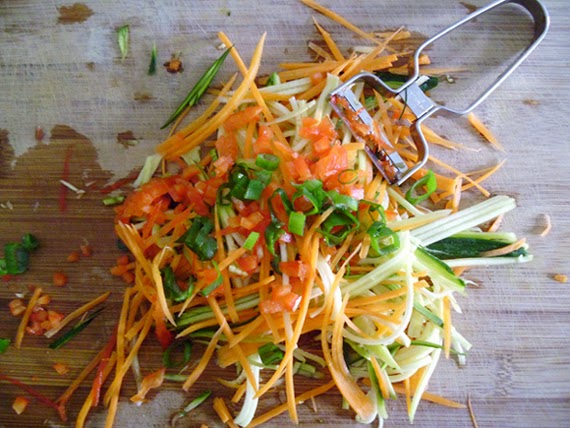
Shred or grate the carrot and courgette.
Finely chop the spring onion greens and red pepper.
Pop all the ingredients into a microwavable plastic soup pot and snap on the lid.

When you're ready for lunch, simply pour on boiling water and allow to stand for a few minutes or add water and pop into a microwave. You'll have a quick, easy and nutritious lunch in no time. Low fodmap to go!


Have a great week - and stay fabulous! x